Share Statewide Bicycle+ System Plan on FacebookShare Statewide Bicycle+ System Plan on X (formerly Twitter)Share Statewide Bicycle+ System Plan on LinkedinEmail Statewide Bicycle+ System Plan link
Image Credit: Waqar Ahmad
Recent Project Updates
The public comment period for the draft Statewide Bicycle+ System Plan has now closed. Thank you for your participation! Please sign up for the project email list to receive future updates.
Introduction
Minnesota has a long and proud history as one of our country's most bicycle friendly states. The Statewide Bicycle+ System Plan (Bike+ Plan) is a guiding document to help Minnesota continue to improve.
A lot has changed sincethe statewide bicycle plan was last updated in 2016 (PDF). Many more people began bicycling for transportation and recreation during the COVID-19 pandemic. More people are using newer transportation devices including scooters, e-bikes, and e-skateboards in communities across Minnesota.
The 2016 plan and the District Bicycle Plans establishedtheStatewide Bicycle Route Network, a network of envisioned connections that link destinations throughout the state by bicycle.The statewide priority corridors are not anticipated to change as part of this update. Instead, this update will build on the previous plans to identify and remove barriers at MnDOT that make it harder to build safe, comfortable, convenient places to bike.
The updated Bike+ Plan will develop vision, goals, and strategies for MnDOT’s role in supporting bicycling and bike-like modes statewide.
Why the +?
The Bike+ Plan includes bikes + bike-like modes. Bike-like modes are other human scale transportation devices that share a similar mass and velocity (kinetic energy, yay science!) to people on bicycles and include folks who are already legally using most types of bicycle facilities found in Minnesota.
Bike-like modes = conventional and electric foot scooters, skateboards, unicycles, etc.
Goals
This plan will align with state transportation policy including Minnesota GO, reflect evolving trends and conditions, and aim to achieve the following goals:
Create safer and more enjoyable places to bike in Minnesota
Identify MnDOT's role in improving bikeways on Trunk Highways, routes that cross Trunk Highways, and facilitating local and regional efforts
Build internal capacity within MnDOT to advance biking
Develop an understanding of current and emerging trends with e-bikes and bike-like devices
Get Engaged
Ask us a question.
During the first phase of engagement, MnDOT talked to community members throughout Minnesota to learn how they currently bike or use bike-like modes, and what barriers they encounter. This included 15 pop-up events throughout the state, meetings with the Diverse Bicycling Perspectives (DBP) advisory group, and feedback from more than 1,176 survey respondents. Below is a summary of what we heard from people who bike or use bike-like modes:
Minnesotans' motivations to ride:
Health: Many associated biking with being physically active, healthy, and feeling mentally refreshed; describing it as stress-relieving because of physical movement and a connection to nature.
Fun: Community members highlighted biking and using bike-like modes as a social activity that allows them to spend time outdoors with friends and family. Many described it as a relaxing, enjoyable way to travel, and emphasized that routes where people can bike together comfortably help sustain interest in biking.
Convenience: High-quality, well-maintained trails and bicycle facilities support biking and bike-like modes as a comfortable and enjoyable option. Many community members shared that e-bikes made it easier, faster, and more enjoyable to bike further and navigate challenging terrain.
Minnesotans' barriers to ride:
Safety: Safety concerns remain the most significant barrier for bicycling and using bike-like modes to travel. Many described being uncomfortable on busy roads, unsafe highway crossings, and gaps in protected bicycle facility networks.
Access: Owning, maintaining, and securely storing bicycles and bike-likes modes are critical barriers for many community members. Lack of access to affordable bicycles, repair services, or safe bicycle parking limited their ability to ride.
Connectivity: A lack of continuous bicycle trails and bicycle infrastructure is a significant barrier for community members. A complete network that connects schools, parks, workplaces, and commercial areas is essential for daily travel and recreational use.
We took your feedback and developed eight strategies that will help guide the different short and long-term policies, goals, and outcomes in the plan. We received input on these strategies – which ones you would prioritize, and how well you think they would impact your ability to bike and roll.
Survey closed: July 24, 2026
Bicycle+ System Plan Update Partner Focus Groups
We are seeking community organizations, bicycling and bike-like mode advocacy groups, or recreational groups and clubs to help gather input on the developed strategies by hosting a short group input activity. The format is adaptable and meant to meet community members where they are – your community centers, homes, virtual meeting spaces, or trailheads – with the goal of having more local voices incorporated into the plan.
Does this sound interesting to you or your organization? Please fill out this short form if interested in learning more about this opportunity to share your input and a project team member will reach out to you: Partner Survey
Image Credit: Waqar Ahmad
Recent Project Updates
The public comment period for the draft Statewide Bicycle+ System Plan has now closed. Thank you for your participation! Please sign up for the project email list to receive future updates.
Introduction
Minnesota has a long and proud history as one of our country's most bicycle friendly states. The Statewide Bicycle+ System Plan (Bike+ Plan) is a guiding document to help Minnesota continue to improve.
A lot has changed sincethe statewide bicycle plan was last updated in 2016 (PDF). Many more people began bicycling for transportation and recreation during the COVID-19 pandemic. More people are using newer transportation devices including scooters, e-bikes, and e-skateboards in communities across Minnesota.
The 2016 plan and the District Bicycle Plans establishedtheStatewide Bicycle Route Network, a network of envisioned connections that link destinations throughout the state by bicycle.The statewide priority corridors are not anticipated to change as part of this update. Instead, this update will build on the previous plans to identify and remove barriers at MnDOT that make it harder to build safe, comfortable, convenient places to bike.
The updated Bike+ Plan will develop vision, goals, and strategies for MnDOT’s role in supporting bicycling and bike-like modes statewide.
Why the +?
The Bike+ Plan includes bikes + bike-like modes. Bike-like modes are other human scale transportation devices that share a similar mass and velocity (kinetic energy, yay science!) to people on bicycles and include folks who are already legally using most types of bicycle facilities found in Minnesota.
Bike-like modes = conventional and electric foot scooters, skateboards, unicycles, etc.
Goals
This plan will align with state transportation policy including Minnesota GO, reflect evolving trends and conditions, and aim to achieve the following goals:
Create safer and more enjoyable places to bike in Minnesota
Identify MnDOT's role in improving bikeways on Trunk Highways, routes that cross Trunk Highways, and facilitating local and regional efforts
Build internal capacity within MnDOT to advance biking
Develop an understanding of current and emerging trends with e-bikes and bike-like devices
Get Engaged
Ask us a question.
During the first phase of engagement, MnDOT talked to community members throughout Minnesota to learn how they currently bike or use bike-like modes, and what barriers they encounter. This included 15 pop-up events throughout the state, meetings with the Diverse Bicycling Perspectives (DBP) advisory group, and feedback from more than 1,176 survey respondents. Below is a summary of what we heard from people who bike or use bike-like modes:
Minnesotans' motivations to ride:
Health: Many associated biking with being physically active, healthy, and feeling mentally refreshed; describing it as stress-relieving because of physical movement and a connection to nature.
Fun: Community members highlighted biking and using bike-like modes as a social activity that allows them to spend time outdoors with friends and family. Many described it as a relaxing, enjoyable way to travel, and emphasized that routes where people can bike together comfortably help sustain interest in biking.
Convenience: High-quality, well-maintained trails and bicycle facilities support biking and bike-like modes as a comfortable and enjoyable option. Many community members shared that e-bikes made it easier, faster, and more enjoyable to bike further and navigate challenging terrain.
Minnesotans' barriers to ride:
Safety: Safety concerns remain the most significant barrier for bicycling and using bike-like modes to travel. Many described being uncomfortable on busy roads, unsafe highway crossings, and gaps in protected bicycle facility networks.
Access: Owning, maintaining, and securely storing bicycles and bike-likes modes are critical barriers for many community members. Lack of access to affordable bicycles, repair services, or safe bicycle parking limited their ability to ride.
Connectivity: A lack of continuous bicycle trails and bicycle infrastructure is a significant barrier for community members. A complete network that connects schools, parks, workplaces, and commercial areas is essential for daily travel and recreational use.
We took your feedback and developed eight strategies that will help guide the different short and long-term policies, goals, and outcomes in the plan. We received input on these strategies – which ones you would prioritize, and how well you think they would impact your ability to bike and roll.
Survey closed: July 24, 2026
Bicycle+ System Plan Update Partner Focus Groups
We are seeking community organizations, bicycling and bike-like mode advocacy groups, or recreational groups and clubs to help gather input on the developed strategies by hosting a short group input activity. The format is adaptable and meant to meet community members where they are – your community centers, homes, virtual meeting spaces, or trailheads – with the goal of having more local voices incorporated into the plan.
Does this sound interesting to you or your organization? Please fill out this short form if interested in learning more about this opportunity to share your input and a project team member will reach out to you: Partner Survey
Share Government and Tribal Partner Webinar #3 Recording on FacebookShare Government and Tribal Partner Webinar #3 Recording on X (formerly Twitter)Share Government and Tribal Partner Webinar #3 Recording on LinkedinEmail Government and Tribal Partner Webinar #3 Recording link
Share Government and Tribal Partner Webinar #2 Recording on FacebookShare Government and Tribal Partner Webinar #2 Recording on X (formerly Twitter)Share Government and Tribal Partner Webinar #2 Recording on LinkedinEmail Government and Tribal Partner Webinar #2 Recording link
Share Webinar #2 On Oct. 30th, 2025 on FacebookShare Webinar #2 On Oct. 30th, 2025 on X (formerly Twitter)Share Webinar #2 On Oct. 30th, 2025 on LinkedinEmail Webinar #2 On Oct. 30th, 2025 link
Share Government and Tribal Partner Webinars on FacebookShare Government and Tribal Partner Webinars on X (formerly Twitter)Share Government and Tribal Partner Webinars on LinkedinEmail Government and Tribal Partner Webinars link
Minnesota has a long and proud history as one of our country’s most bicycle friendly states and that is only possible because of the local, regional, and statewide networks built by a variety of partners.
Local partners and tribal nations will play a crucial role in the development of the Bike+ Plan. MnDOT is trying something a little new for the Bike+ Plan statewide planning cooperation and coordination process with our government partners. If you play a role in developing bicycle facilities at an MPO, RDO, County, City, or Tribal Nation you are invited to a series of Bike+ Plan Government and Tribal Partner Webinars.
At the MnDOT Bike+ Plan Government and Tribal Partner Webinars partners will be able to:
Hear updates about the Bike+ Plan’s progress
Learn what you can do to support the planning process
Provide feedback directly to the Plan’s project management team
Schedule an opportunity for a 1:1 follow with the project manager if needed
Check back here for dates for upcoming webinars and recordings of past webinars.
Minnesota has a long and proud history as one of our country’s most bicycle friendly states and that is only possible because of the local, regional, and statewide networks built by a variety of partners.
Local partners and tribal nations will play a crucial role in the development of the Bike+ Plan. MnDOT is trying something a little new for the Bike+ Plan statewide planning cooperation and coordination process with our government partners. If you play a role in developing bicycle facilities at an MPO, RDO, County, City, or Tribal Nation you are invited to a series of Bike+ Plan Government and Tribal Partner Webinars.
At the MnDOT Bike+ Plan Government and Tribal Partner Webinars partners will be able to:
Hear updates about the Bike+ Plan’s progress
Learn what you can do to support the planning process
Provide feedback directly to the Plan’s project management team
Schedule an opportunity for a 1:1 follow with the project manager if needed
Check back here for dates for upcoming webinars and recordings of past webinars.
Share Government and Tribal Partner Webinar #1 Recording on FacebookShare Government and Tribal Partner Webinar #1 Recording on X (formerly Twitter)Share Government and Tribal Partner Webinar #1 Recording on LinkedinEmail Government and Tribal Partner Webinar #1 Recording link
Page last updated: 23 Oct 2026, 08:02 PM
Project Kickoff: November 2024
Statewide Bicycle+ System Plan has finished this stage
Insight Engagement Phase: Spring 2025 - Fall 2025
Statewide Bicycle+ System Plan has finished this stage
Gather Minnesotans’ experiences and desires around bicycling and bike-like modes.
Drafting Plan and Integrating Engagement Feedback
Statewide Bicycle+ System Plan has finished this stage
Accountability Engagement Phase: Summer 2026
Statewide Bicycle+ System Plan has finished this stage
Share how engagement phase 1 input shaped the plan.
Draft Plan: Summer 2026
Statewide Bicycle+ System Plan is currently at this stage
Final Plan: Fall 2026
this is an upcoming stage for Statewide Bicycle+ System Plan

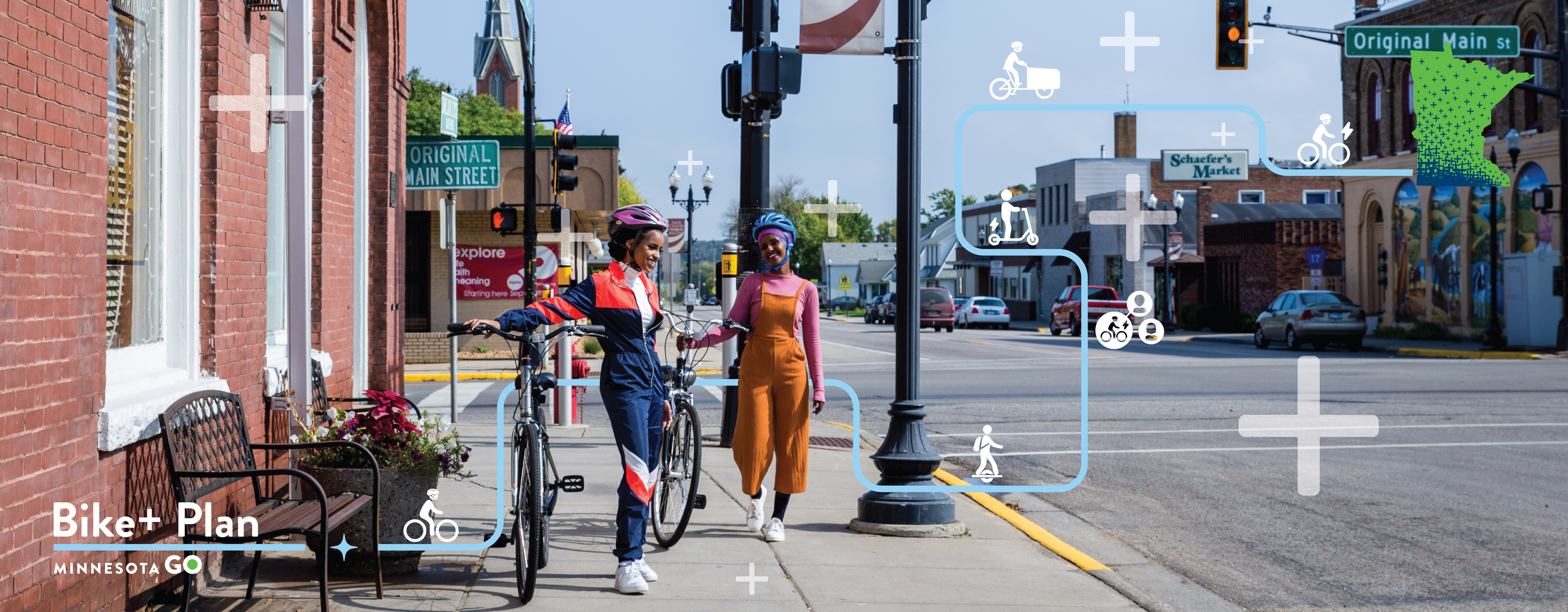 Image Credit: Waqar Ahmad