Hwy 51/Snelling Ave. and Montreal Ave. study – St. Paul

Share Hwy 51/Snelling Ave. and Montreal Ave. study – St. Paul on Facebook Share Hwy 51/Snelling Ave. and Montreal Ave. study – St. Paul on X (formerly Twitter) Share Hwy 51/Snelling Ave. and Montreal Ave. study – St. Paul on Linkedin Email Hwy 51/Snelling Ave. and Montreal Ave. study – St. Paul link

About this study

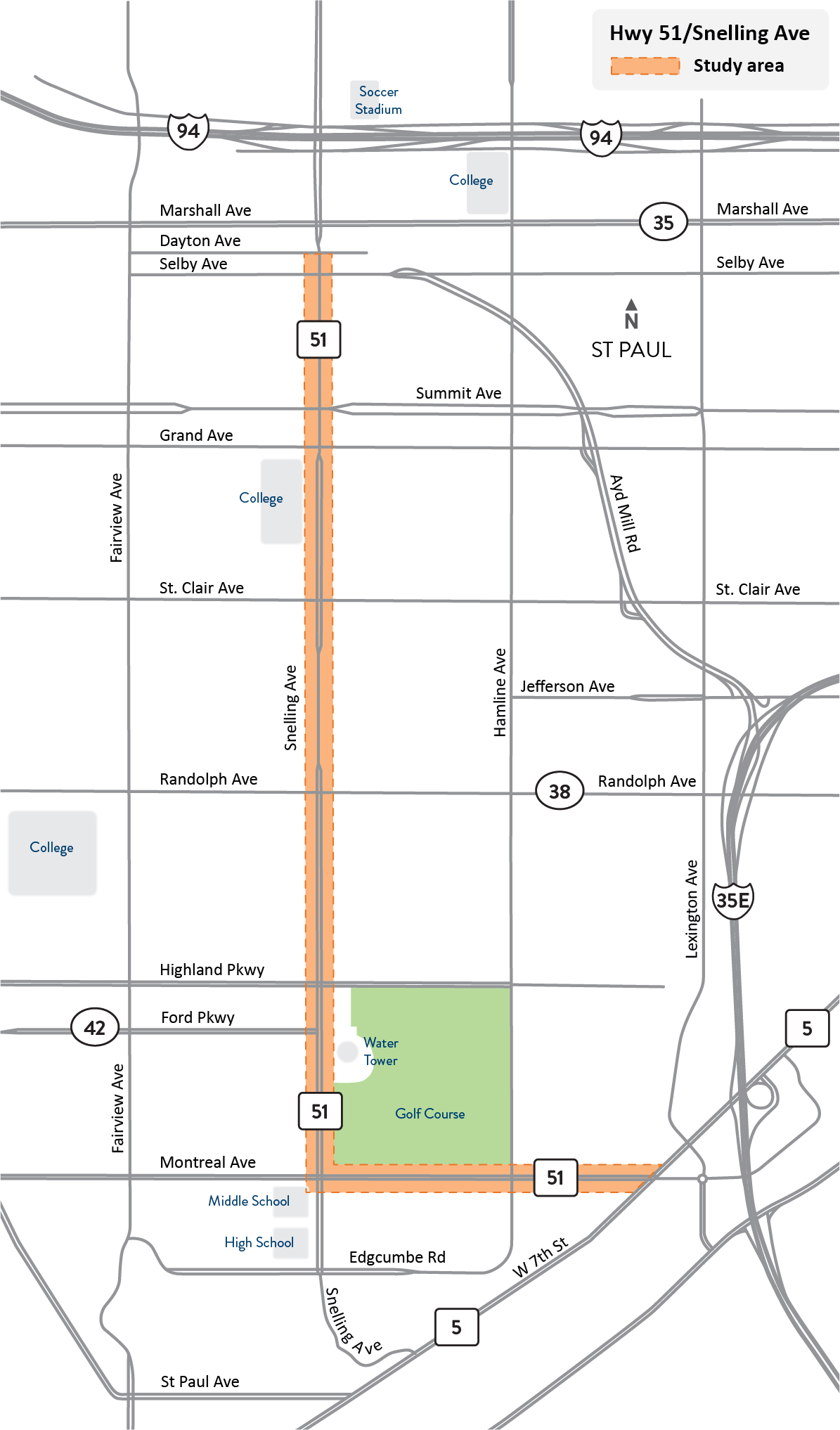
Highway 51/Snelling Avenue and Montreal Avenue from Dayton Avenue to Highway 5/West Seventh Street study location mapView full-size map We are studying Snelling Ave. and Montreal Ave. from Dayton Ave. to Hwy 5/West Seventh St. in St. Paul to understand what needs and opportunities exist in the area to help inform future projects along the road including a planned resurfacing project scheduled for construction between 2030 and 2031. We anticipate that improved safety and accessibility will emerge as key needs. The study will help to ensure that future projects include features that meet the needs of all users in the area, including pedestrians, bicyclists, transit users and drivers.

Several portions of Snelling Ave. have undergone recent improvements, including between Grand Ave. and St. Clair Ave. which had a signal replacement at St. Clair Ave. and pedestrian improvements throughout in 2024. The segment between Ford Pkwy. and Montreal Ave. was also improved in 2024 with a four-to-three lane conversion, pedestrian refuge islands and a signal replacement at Montreal Ave. and Snelling Ave.

This study will seek the public’s input to better understand existing conditions and the transportation needs of all users through a variety of engagement events, including public meetings and surveys. We will also ask for feedback on potential improvements in the study area to establish a shared vision among study partners. Where possible, some of the short-term recommendations may be integrated into a resurfacing project between 2030 and 2031.

Summary of work

  • Assess and document existing conditions
  • Ask people to share their transportation experiences and needs
  • Produce a document that identifies transportation needs and opportunities in the study area
  • Develop and evaluate recommended improvements and get public input
  • Develop next steps for advancing the recommended improvements

Get involved

As a part of this study, we will be gathering input from community through public meetings, events and surveys.

  • Engagement summary – October 2026

    Share Engagement summary – October 2026 on Facebook Share Engagement summary – October 2026 on X (formerly Twitter) Share Engagement summary – October 2026 on Linkedin Email Engagement summary – October 2026 link

    From June 29 to August 5, we engaged the community to understand what needs and opportunities exist to help inform future projects along Snelling Ave. and Montreal Ave. in St. Paul. We are planning a resurfacing project along the road between 2030 and 2031.

    This first phase of the study focused on asking community members about their general use, challenges and comfort level in the study area. During the two months, the study team received 881 comments from people who live or travel in the study area.

    Engagement included a survey, an online comment map, an in-person public meeting, a

    From June 29 to August 5, we engaged the community to understand what needs and opportunities exist to help inform future projects along Snelling Ave. and Montreal Ave. in St. Paul. We are planning a resurfacing project along the road between 2030 and 2031.

    This first phase of the study focused on asking community members about their general use, challenges and comfort level in the study area. During the two months, the study team received 881 comments from people who live or travel in the study area.

    Engagement included a survey, an online comment map, an in-person public meeting, a virtual public meeting and two pop-up events. These events were promoted with the website, study emails and through social media.

    Engagement activities

    Survey
    June 29 - Aug. 5

    The study team developed a survey asking about general use, challenges and comfort level along the study area. The survey garnered 443 responses, including 6 responses from businesses.

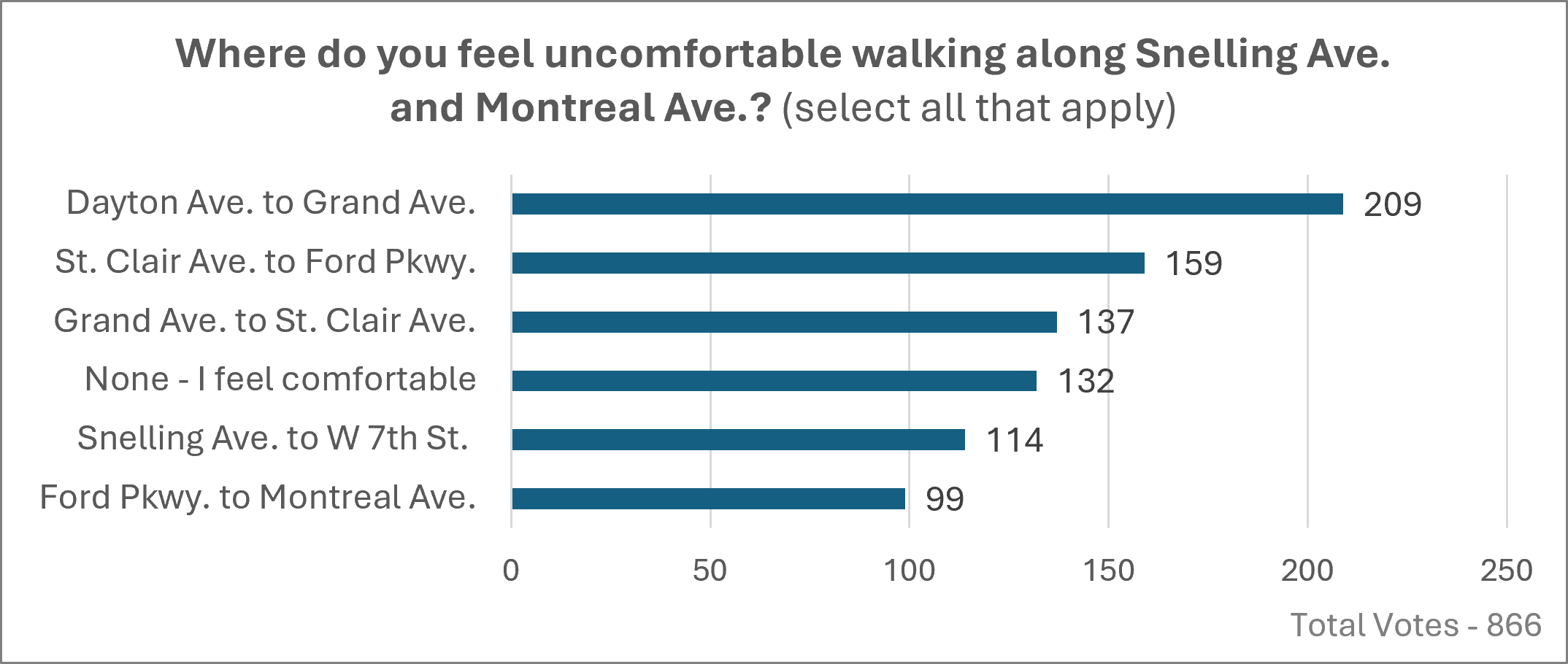
    A bar graph showing the answers to the survey question “Where do you feel most uncomfortable walking along Snelling Avenue and Montreal Avenue? Select all that apply.” The survey options had the following responses: Dayton Avenue to Grand Avenue 209, Saint Clair Avenue to Ford Parkway 159, Grand Avenue to Saint Clair Avenue 137, None I feel comfortable 132, Snelling Avenue to West Seventh Street 114, Ford Parkway to Montreal Avenue 99.

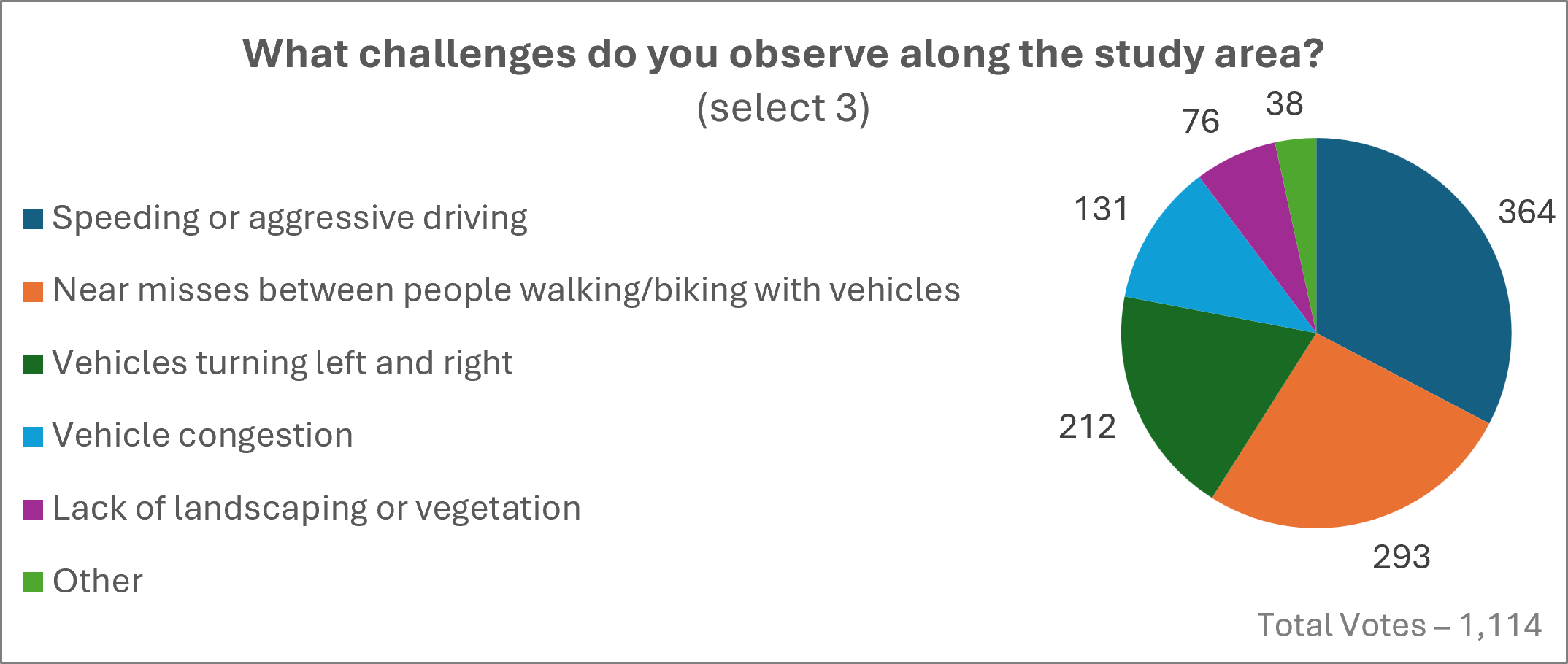
    A pie chart showing the answers to the survey question “What challenges do you observe along the study area? Select 3.” The survey options had the following responses: Speeding or aggressive driving 364, near misses between people walking/bike with vehicles 293, vehicle turning left and right 212, vehicle congestion 131, lack of landscaping and vegetation 76, other 38.

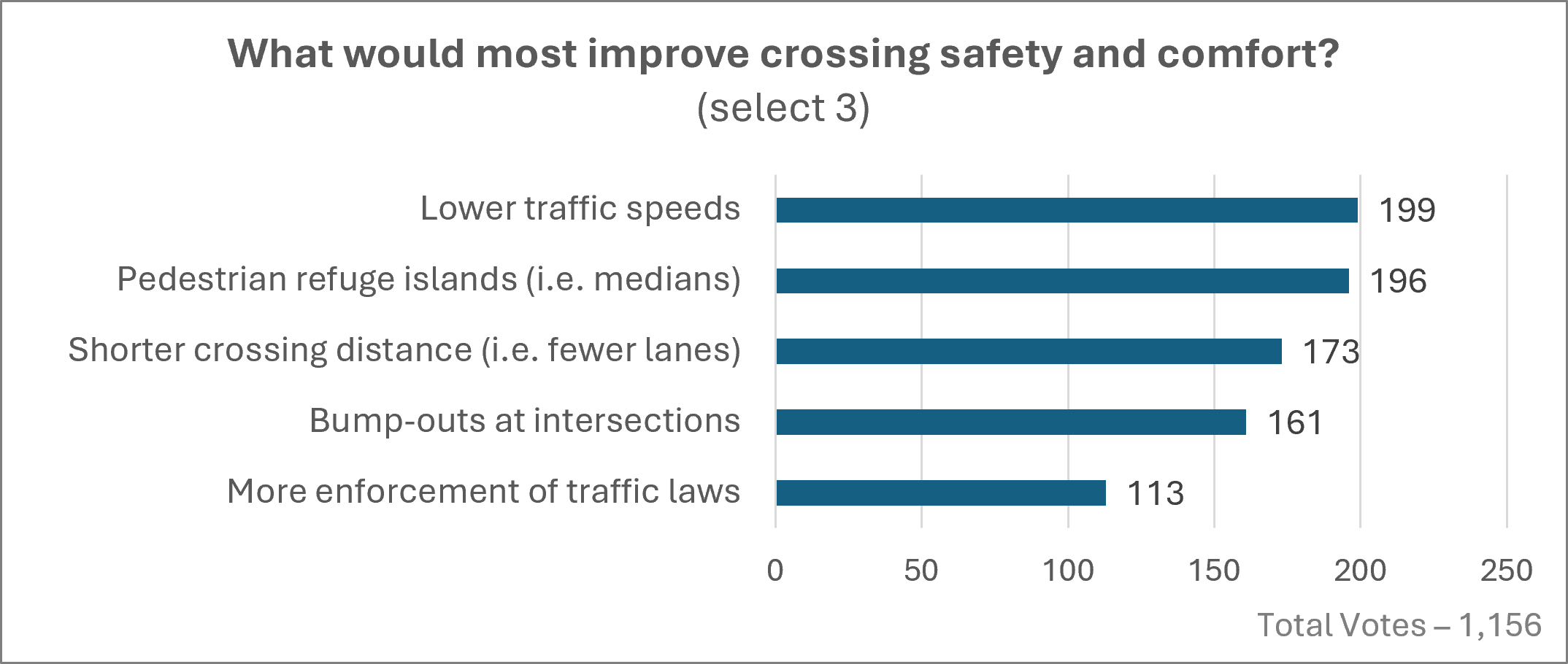
    A bar graph showing the answers to the survey question “What would most improve crossing safety and comfort? Select 3.” The survey options had the following responses: lower traffic speeds 199, pedestrian refuge island such as medians 196, shorter crossing distances such as fewer lans 173, bump-outs at intersections 161, more enforcement of traffic laws 113.

    Comment map
    June 29 - Aug. 5

    An interactive comment map allowed participants to drop a pin on locations in the study area, with the following categories: biking/rolling issues, walking issues, driving issues, transit accessibility issues, crossing issues, other issues, ideas/improvements and what is working well. After identifying a location, users could also provide a comment on each pin. The map garnered 230 responses from 72 participants.

    Public meetings
    In-person at Macalester College, 5-7 p.m. on Wed, July 22
    Virtual, 6-7 p.m. on Wed, July 29

    We hosted two public meetings, one in-person at Macalester College and one virtual. Both meetings included a presentation followed by an open house-style conversation. The in-person meeting had boards, a mapping activity and information on other projects near the study area. Approximately 35 people combined attend the public meetings. Watch a recording of the virtual public meeting.

    Pop-ups
    Dayton Ave. and Snelling Ave. transit station, 4-6 p.m. on Tue, July 7
    Highland Water Tower open house, 11 a.m.-1 p.m. on Sat, July 18

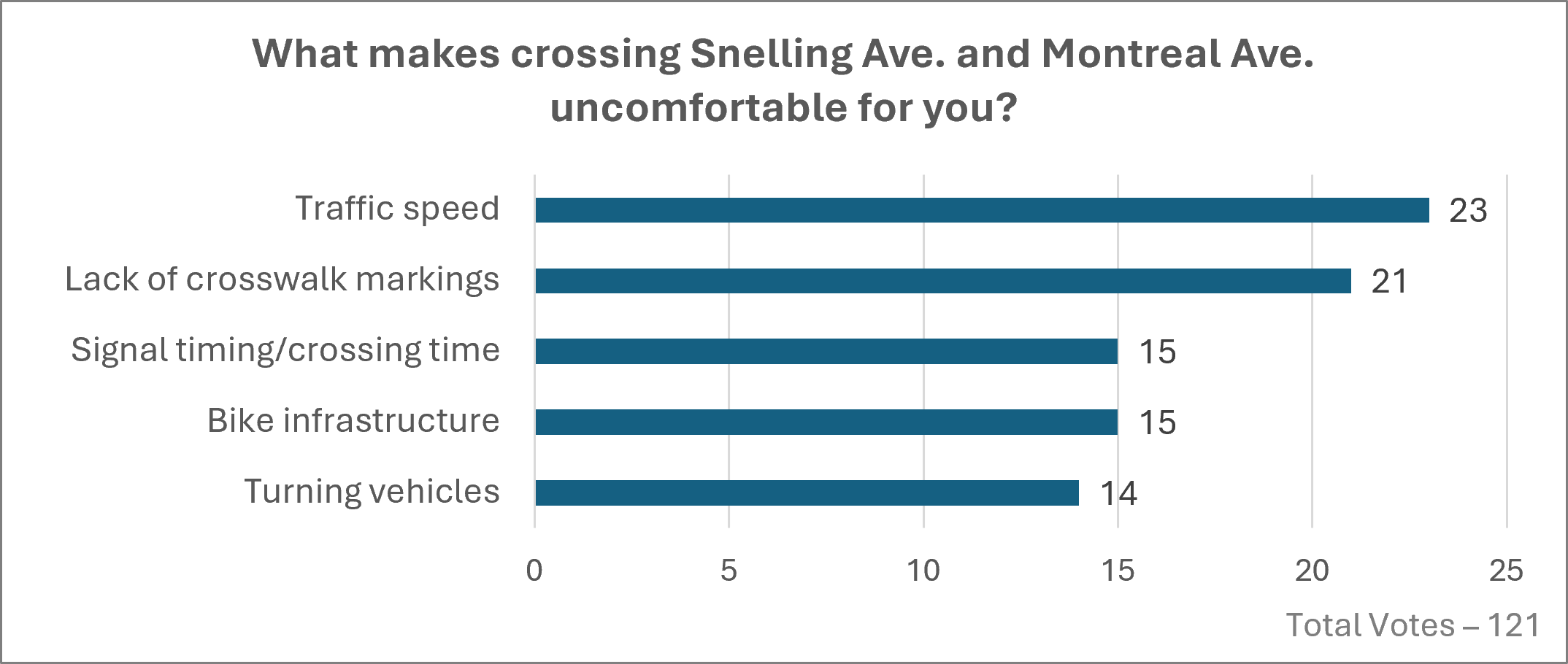
    We staffed informational booths at a Meto Transit bus stop and community event along Snelling Ave. We had conversations about the study with a total of 148 people, asking them what improvements they would like to see. Participants at the pop-up events were invited to leave comment cards and vote on their most pressing concerns with an interactive sticker activity, which resulted in 121 “votes”.

    A bar graph showing the answers to the survey question “What makes crossing Snelling Ave. and Montreal Ave. uncomfortable for you?” The survey options had the following responses: traffic speeds 23, lack of crosswalk markings 21, signal timing/crossing time 15, bike infrastructure 15, turning vehicles 14.

    General themes

    During public engagement, several recurring comments emerged:

    • People do not feel comfortable traveling on Snelling Ave. and Montreal Ave. because they believe vehicles speed or are otherwise too aggressive.
    • Many people felt especially unsafe crossing Snelling Ave. and want to see pedestrian infrastructure improvements such as pedestrian median islands, rectangular rapid flashing beacons (RRFBs) and bump-outs.
    • There is also interest in improving biking experience since people feel unsafe biking along Snelling Ave. and Montreal Ave. and find it inconvenient to bike along parallel routes.
    • Many people felt that vehicle turning movements at intersections were unsafe for other drivers and pedestrians alike.
    • There is support for improved bus infrastructure.

    Overall, the most frequently mentioned locations along Snelling Ave. were at the following intersections:

    • Dayton Ave. - Pedestrians and bus riders feel unsafe crossing here and that aggressive driving is a concern.
    • Selby Ave. – Pedestrians feel unsafe because of turning vehicles, and high traffic volumes conversely drivers feel frustrated due to long wait for left-turns.
    • Grand Ave. – Pedestrian volume is very high here; making turns (right and left) is complicated.
    • Randolph Ave. – Pedestrians feel unsafe here; many mentions of pedestrian-driver turning conflicts.
    • Jefferson Ave. – Desire for better pedestrian signals and improved bike infrastructure along Jefferson Ave. bike boulevard.
    • Palace Ave. – Pedestrians desire safer crossing to access Mattocks Park.
    • Ford Pkwy. – Dual left is confusing and makes it difficult to see pedestrians.
    • Montreal Ave. – Concerns regarding slip lane.

    Next steps

    Using the current conditions of the road and the public input we received, we’ll develop solutions to address the needs and opportunities. These solutions will be shared with the public for additional feedback later this winter.


  • Study update - August 2026

    Share Study update - August 2026 on Facebook Share Study update - August 2026 on X (formerly Twitter) Share Study update - August 2026 on Linkedin Email Study update - August 2026 link

    In July and August, we asked community members to share their experiences with Snelling Ave. and Montreal Ave. through public meetings, community events, and an online survey and comment map. Thank you to everyone who took part.

    The study team is reviewing what we heard and documenting current road conditions. This information will help us develop potential improvement ideas. We’ll share those ideas and ask for more public feedback later in the study.

    The online survey and comment map closed on Wed, Aug. 5. If you weren’t able to participate or couldn’t attend a meeting, you can still share your

    In July and August, we asked community members to share their experiences with Snelling Ave. and Montreal Ave. through public meetings, community events, and an online survey and comment map. Thank you to everyone who took part.

    The study team is reviewing what we heard and documenting current road conditions. This information will help us develop potential improvement ideas. We’ll share those ideas and ask for more public feedback later in the study.

    The online survey and comment map closed on Wed, Aug. 5. If you weren’t able to participate or couldn’t attend a meeting, you can still share your thoughts. Leave a comment and send us questions, or reach out to the study team anytime.

    You can also watch the online public meeting recording to learn more about the study.

    Sign up for email updates to stay informed and learn about future opportunities to share your input.

  • Meetings and events

    Share Meetings and events on Facebook Share Meetings and events on X (formerly Twitter) Share Meetings and events on Linkedin Email Meetings and events link

    Public meetings and events

    Upcoming

    Information on upcoming meetings will be posted as details become available. Sign up for email updates to receive information on upcoming meetings and opportunities to provide feedback on this study.

    Past

    July 29, 2026: Virtual public meeting

    July 22, 2026: In-person public meeting, Macalester College, St. Paul

    July 18, 2026: In-person outreach, Highland Tower pop-up, St. Paul

    July 7, 2026: In-person outreach, Dayton Ave. bus station, St. Paul

    Public meeting accommodations

    MnDOT invites and encourages participation by all people in their programs, services and activities. If you need an ASL, a

    Public meetings and events

    Upcoming

    Information on upcoming meetings will be posted as details become available. Sign up for email updates to receive information on upcoming meetings and opportunities to provide feedback on this study.

    Past

    July 29, 2026: Virtual public meeting

    July 22, 2026: In-person public meeting, Macalester College, St. Paul

    July 18, 2026: In-person outreach, Highland Tower pop-up, St. Paul

    July 7, 2026: In-person outreach, Dayton Ave. bus station, St. Paul

    Public meeting accommodations

    MnDOT invites and encourages participation by all people in their programs, services and activities. If you need an ASL, a foreign language interpreter, or documents in an alternative format (such as braille, large print or in a different language) at no cost, please email your request to Janet Miller at ADArequest.dot@state.mn.us or call 651-366-4720. Relay service: 711.

    If you need any other reasonable accommodation to participate (such as seating modification or auxiliary aids), please email your request to Accessibility.DOT@state.mn.us or call 1-833-400-8432. Relay service: 711.

  • Accessibility

    Share Accessibility on Facebook Share Accessibility on X (formerly Twitter) Share Accessibility on Linkedin Email Accessibility link

    Americans with Disabilities ActSpeakers and raised arrows on APS signals provide information about the intersection to pedestrians with hearing and visual impairment.

    All MnDOT - both new construction and rehabilitation projects - must include evaluation to ensure compliance with the Americans with Disabilities Act. Components can include, but are not limited to adding curb cuts, truncated domes and accessible pedestrian signals. Read about MnDOT's transition plan to comply with the ADA.

    Specifics for this study

    • Determine what accessibility improvements are needed for a 2030 resurfacing project
    Americans with Disabilities ActSpeakers and raised arrows on APS signals provide information about the intersection to pedestrians with hearing and visual impairment.

    All MnDOT - both new construction and rehabilitation projects - must include evaluation to ensure compliance with the Americans with Disabilities Act. Components can include, but are not limited to adding curb cuts, truncated domes and accessible pedestrian signals. Read about MnDOT's transition plan to comply with the ADA.

    Specifics for this study

    • Determine what accessibility improvements are needed for a 2030 resurfacing project
Page last updated: 23 Oct 2026, 06:24 AM